
Last Updated: November 1, 2026
Quick Summary
The best flowers for leafcutter bees in small gardens are lavender, bee balm, sunflowers, cosmos, and black-eyed Susans. Each offers easy pollen and nectar access, fits a pot or narrow bed, and blooms in sequence from early summer into fall. Cluster them in the largest pots you can manage so leafcutter bees find them easily.
- Lavender blooms in early summer and needs full sun with sharp drainage.
- Bee balm spreads by runners, so give it its own sizable pot.
- Choose dwarf sunflower varieties for patio containers and stake them against wind.
- Cosmos blooms from summer to frost and works as an easygoing filler.
- Black-eyed Susans carry the season into fall with raised centers small bees can work.
Table of Contents
- Why Leafcutter Bees Earn Their Tiny Scissors in a Small Garden
- The Top 5 Flowers for Leafcutter Bees in Small Gardens
- Leafcutter Bee Friendly Plants That Fit a Balcony or Patio
- Native Flowers for Bees: Regional Picks Worth Planting
- Bee-Friendly Garden Design for Tight Spaces
- Give Them a Home: Choosing a Leafcutter Bee House
- Preorder Your Kind Bee Farms Kit and Plant the First Bloom
- Frequently Asked Questions
Why Leafcutter Bees Earn Their Tiny Scissors in a Small Garden
A leafcutter bee is a solitary, non-aggressive pollinator that nests in narrow tube-like cavities and clips neat circles from leaves to line each brood cell. For anyone tending a compact garden, that is very good news.
This guide from Kind Bee Farms focuses on the top 5 flowers for leafcutter bees in small gardens. We have been a family bee business since 1990. Below, we will show you exactly which blooms earn their space, how to stagger them across the season, and where to house the bees once your flowers are ready.
Here is the part most guides get wrong: they list bee-friendly plants without asking whether a leafcutter bee can actually reach the pollen. Flower shape matters as much as flower color. A bloom that suits a honeybee may be useless to a small solitary bee with a short reach.
The Top 5 Flowers for Leafcutter Bees in Small Gardens
The best flowers for leafcutter bees in small gardens are lavender, bee balm, sunflowers, cosmos, and black-eyed Susans. Each one offers easy access to pollen and nectar, fits a container or narrow bed, and blooms in a sequence that keeps foraging steady from early summer into fall.
1. Lavender: The Low-Water Workhorse
Lavender tops many gardeners’ lists because it packs dozens of tiny flowers into one compact shrub. Those small florets give a leafcutter bee plenty of nectar in a short flight. It also tolerates dry spells, which makes it forgiving for a busy household. Plant it in full sun and give it sharp drainage. One honest limitation: lavender sulks in heavy, wet soil, so raise the bed or use a pot if your ground holds water. Improving the drainage of your garden beds often requires incorporating specific plants for heavy clay soil to ensure that your lavender thrives throughout the season.
2. Bee Balm: A Nectar Buffet With a Minty Attitude
Bee balm is a magnet for pollinators, and its tubular flowers suit small bees nicely. It spreads readily, so give it a corner where it can wander. A common mistake is planting it in the middle of a tidy border; it will happily colonize the neighbors.
3. Sunflowers: Big Blooms for Tiny Patios
A dwarf sunflower fits a patio pot and produces a wide landing pad of florets. That single flowerhead can keep several bees busy at once. Choose compact varieties for containers and stake them against wind.
4. Cosmos: The Cheerful Space-Filler
Cosmos is the easygoing filler that keeps blooming when other plants fade. Its open, saucer-shaped flowers give leafcutter bees a clear approach. Sow it directly and thin the seedlings; it rewards a little neglect.
5. Black-Eyed Susans: Late-Season Gold
Black-eyed Susans carry the season into fall, when foraging options thin out. Their raised centers are simple for a small bee to work. They self-seed, so expect a few volunteers next spring.
| Flower | Bloom Window | Sun Needs | Best Spot | Why Leafcutters Like It |
|---|---|---|---|---|
| Lavender | Early summer | Full sun | Sunny pot or border | Many tiny florets, short flight |
| Bee Balm | Midsummer | Full sun to part shade | Spreading corner | Tubular blooms, heavy nectar |
| Sunflower | Midsummer | Full sun | Patio container | Wide floret landing pad |
| Cosmos | Summer to frost | Full sun | Filler gaps | Open, easy-access flowers |
| Black-Eyed Susan | Late summer to fall | Full sun | Back of bed | Raised center, late food |
Leafcutter Bee Friendly Plants That Fit a Balcony or Patio
Start with pot size, not plant choice. A leafcutter bee forages by sight, and a bold block of color is easier to find than a scattering of lonely blooms.
A five-pot layout that fits a balcony
- Pot 1 (back, tallest): dwarf sunflower. Choose a compact variety so it does not shade the rest. One stake against wind is cheap insurance.
- Pot 2 (middle): bee balm. Give it its own pot, because it spreads by runners and will happily colonize its neighbors. A sizable pot keeps it contained and still generous.
- Pot 3 (middle): lavender. Full sun and sharp drainage; add grit to the potting mix if your soil holds water. It sulks in wet feet, so do not overwater.
- Pot 4 (front): cosmos. Sow directly and thin the seedlings as they grow. It is the easygoing filler that keeps blooming when other plants fade.
- Pot 5 (front or edge): black-eyed Susan. It carries the season into fall, and its raised center is simple for a small bee to work.
Stagger the bloom, not just the plants. The real trick in a small space is succession. Early summer belongs to lavender. Midsummer is bee balm and sunflower.
Spacing and airflow matter more than you think. Crowded pots invite mildew, especially with bee balm.
Do not forget water and pesticide-free zones. Leave a shallow dish of water with a few pebbles so bees can drink without drowning.
Once the flowers are set, the missing piece is shelter.
Native Flowers for Bees: Regional Picks Worth Planting
Native plants are already adapted to your local rainfall, soil, and temperature swings, which makes them low-effort and high-reward in a small garden. Before you shop, look up your hardiness zone so you pick species that will survive your winters instead of sulking through them.
Here is the part most regional lists skip: leafcutter bees are small, short-reach foragers, so the most useful native plants are the ones with shallow, open, or clustered florets rather than long, deep tubes.
Northeast and Midwest
- Wild bergamot (Monarda fistulosa): a native cousin of bee balm, blooming midsummer, and a reliable nectar source for small bees. It spreads, so give it a defined corner.
- Purple coneflower (Echinacea purpurea): the raised, cone-shaped center is easy for a leafcutter bee to work, and it blooms from midsummer into early fall.
- New England aster (Symphyotrichum novae-angliae): a late-season lifeline when most other flowers are done. Pinch it back in early summer to keep it compact in a small bed.
South
- Scarlet sage (Salvia coccinea): a compact, heat-tolerant bloomer that keeps producing through the hottest stretch of summer.
- Black-eyed Susan (Rudbeckia hirta): already on our top-five list, and it is native across much of the region, so it pulls double duty.
- Blanket flower (Gaillardia): a low, spreading plant with open daisy-like blooms that suit short-reach bees and tolerate poor soil.
West
- California poppy (Eschscholzia californica): an open, cup-shaped bloom that is simple for small bees to enter, and it self-seeds politely in dry gardens.
- Penstemon: choose compact species for containers; the tubular flowers reward bees that can reach, and many penstemon bloom in late spring to early summer.
- Rocky Mountain bee plant (Cleome serrulata): a tall, airy native that draws a crowd of pollinators and fills vertical space at the back of a bed.
Pacific Northwest
- Oregon sunshine (Eriophyllum lanatum): a low, sunny daisy that handles cool, wet springs and blooms in early summer.
- Camas (Camassia quamash): a spring bloomer that gives early foragers a head start before the summer workhorses open.
- Red flowering currant (Ribes sanguineum): a spring-blooming shrub that works as a small-garden anchor plant and feeds early-season bees.
For more on what these gentle bees are and why they suit small spaces, a leafcutter bee overview is a friendly place to start. We think you will enjoy the read, and so will your tomatoes.
Bee-Friendly Garden Design for Tight Spaces
Good bee-friendly garden design starts with one rule: cluster, don’t scatter. A single generous patch of lavender draws more visits than the same plants spread thin across a yard.
Next, build vertical layers. Tall sunflowers at the back, mid-height bee balm in the middle, and low cosmos at the front. This gives bees multiple flight levels and gives you a garden that looks intentional.
Add a few flowering trees or fruit blossoms if you have room at the edges. Apple, cherry, plum, pear, and blueberry all reward leafcutter activity, and their spring bloom gives early foragers a head start.
Give Them a Home: Choosing a Leafcutter Bee House
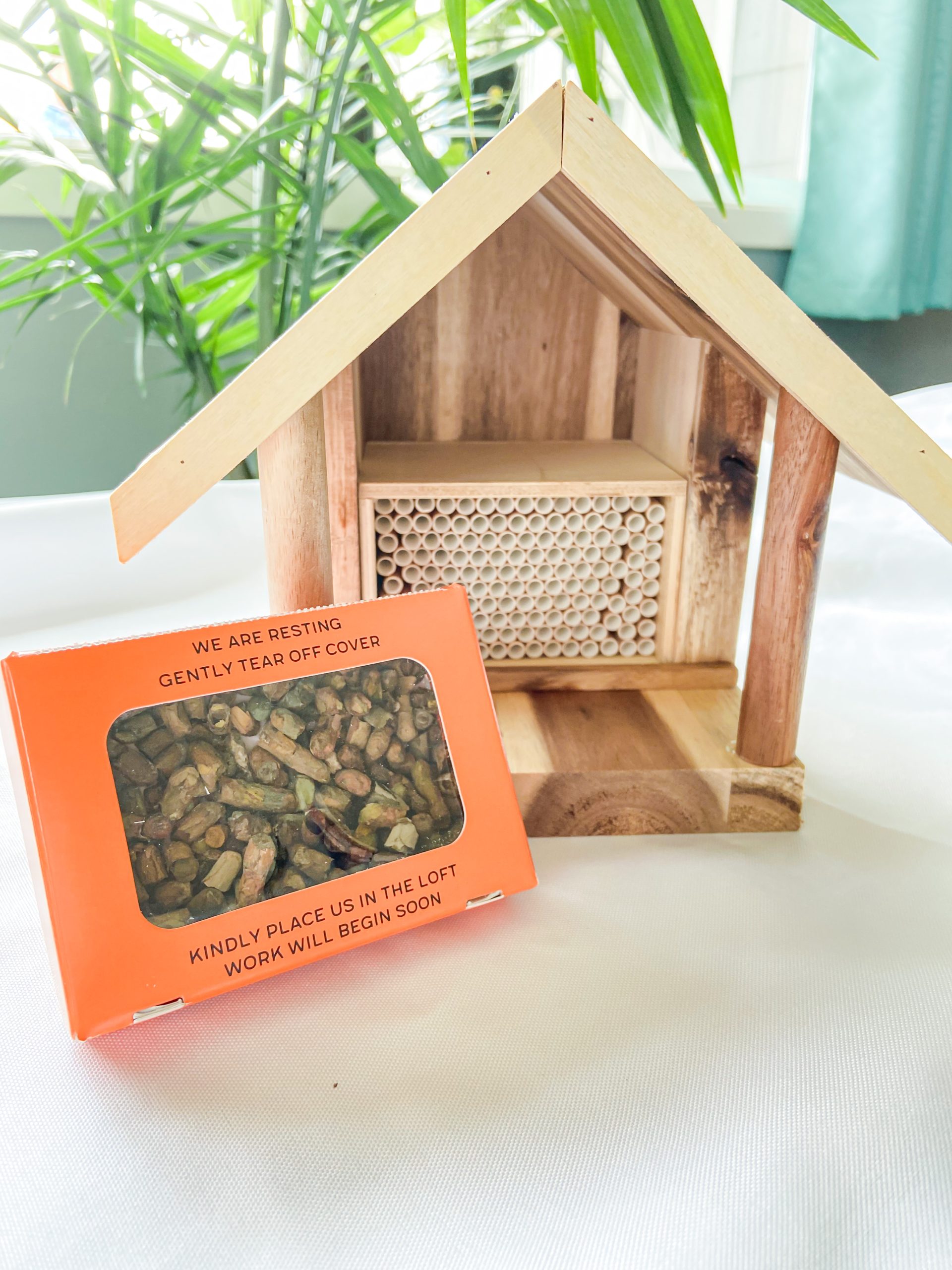
A leafcutter bee house is a simple structure with narrow nesting tubes that gives solitary bees a dry, safe place to lay eggs. The material matters more than the shape.
We only use smooth paper-like straws for the nesting tubes in our houses.
Place the house facing morning sun, mounted at roughly eye level, and sheltered from rain. Our all-in-one pollinator kits include the bee house, the cocoons, and the nesting tubes, so you are not hunting down pieces separately. They are designed for leafcutter bees specifically, which means no guesswork.
Preorder Your Kind Bee Farms Kit and Plant the First Bloom
The real challenge is not choosing flowers. It is getting flowers, shelter, and timing to line up in the same small space. A patch of lavender with nowhere to nest is only half a habitat.
That is the gap our kits close. Every Kind Bee Farms kit ships with a bee house, leafcutter bee cocoons, and smooth paper-like nesting tubes, built around one clear goal: making pollination simple for families.
Get started with Kind Bee Farms and give your garden the pollinators it has been waiting for. Preorder your leafcutter bee cocoons and plant the first bloom.
Frequently Asked Questions
What flowers are best for bees in a small garden?
The best flowers for leafcutter bees in a small garden are ones that pack lots of small blooms into limited space. Lavender, bee balm, cosmos, black-eyed Susans, and dwarf sunflowers all work well because each plant offers many flowerheads at once. Aim for a mix that blooms from early summer into fall so foraging bees always have pollen and nectar nearby. Grouping three or more of the same plant together makes it easier for leafcutter bees to spot and visit them.
Do leafcutter bees like roses?
Leafcutter bees do visit roses for pollen, but they are also famous for snipping neat circles from rose leaves to line their nests. That leaf-cutting is normal behavior and rarely harms a healthy shrub. If you grow shrub roses in a small garden, expect a few tidy half-moons along the leaf edges. It is a small trade for the pollination they provide to your vegetables and fruit trees.
Do leafcutter bees need a bee house?
Yes, leafcutter bees need a sheltered nesting site, and a leafcutter bee house gives them that. Unlike honeybees, they do not build hives; they nest in narrow tubes. Kind Bee Farms kits include a bee house and smooth paper-like straws for nesting tubes, which are easy to clean and replace between seasons. Place the house facing morning sun, off the ground, and away from bird feeders.
How can I attract leafcutter bees to my garden?
Plant a compact mix of leafcutter bee friendly plants like lavender, cosmos, and bee balm, then add a leafcutter bee house nearby. Provide a shallow water source and leave a few fallen leaves or soft plant material for nest-building. Avoid spraying pesticides while flowers are in bloom. A single well-placed bee house plus a steady supply of blooms gives leafcutter bees a reason to stay and pollinate your vegetables and fruit trees.
