
Last Updated: October 26, 2026
Quick Summary
Observe leafcutter bees with kids by sitting quietly near the bee house, hunting for round leaf cuts, and keeping a simple observation journal. Watch from one arm’s length away, never open sealed tubes, and let the gentle bees come to you.
- Leafcutter bees are solitary, gentle, and almost never sting, making them kid-friendly pollinators.
- Set a ten-minute timer and count bees entering a nesting tube.
- Give kids a notebook with date, weather, and sightings columns; drawings count as entries.
- Choose one tube and check it each morning until the entrance is sealed.
- Match activities to attention span: ages 3-5 do the relay and sit-and-watch for 5-10 minutes.
Table of Contents
- Why Leafcutter Bees Are the Perfect Backyard Teachers
- Know Your Neighbor: How to Tell a Leafcutter Bee From Other Bees
- The Leafcutter Bee Life Cycle, Told as a Bedtime Story
- How to Observe Bees Safely Without Spoiling the Fun
- Bee Observation Activities for Kids: Seven Ideas That Actually Work
- Matching Activities to Your Child’s Age (and Attention Span)
- Set Up a Pollinator House and Let the Show Begin
- Frequently Asked Questions
Why Leafcutter Bees Are the Perfect Backyard Teachers
Leafcutter bees are small, gentle solitary bees that nest in paper-like tubes and pollinate many garden plants. They do not live in a hive, they do not guard honey, and they almost never sting. That makes them about as kid-friendly as a pollinator can get. Curious kids can enjoy five fun facts about leafcutter bees before the activities begin.
Here at Kind Bee Farms, we have been a family bee business since 1990.
Below are seven activities for observing leafcutter bees with kids. Grab a lawn chair. This is going to be fun.
Know Your Neighbor: How to Tell a Leafcutter Bee From Other Bees
A leafcutter bee is a solitary bee with a fuzzy body, a mild sting, and a habit of cutting neat circles from leaves. It looks quite different from a honeybee or a bumblebee once you know what to check.
Here is a quick field guide:
- Body shape: leafcutter bees carry pollen on their belly, so the underside looks fuzzy and often golden (Leafcutter Bees)
- Color: usually dark with pale stripes, smaller than a bumblebee
- Flight: fast and zigzagging, often low around flowers
- Nesting: smooth paper-like straws or tunnels, never a big shared hive
- Temperament: non-aggressive, happy to share space
Mason bees look similar but carry pollen on their belly too, while carpenter bees are much larger and drill into wood. For a closer look at how solitary bees like mason, carpenter, and leafcutter bees differ, this guide digs into each one.
The Leafcutter Bee Life Cycle, Told as a Bedtime Story
The leafcutter bee life cycle runs from egg to larva to cocoon to adult, all inside one nesting tube.
From Egg to Emergence: What Kids Will Actually See
Picture a tiny straw in a bee house. A female bee lays an egg on a pollen ball, then seals the room with a leaf wall.
- Spring: cocoons arrive and warm up
- Early summer: adults emerge and mate
- Summer: females cut leaves and fill tubes
- Fall: tubes are full and quiet
- Winter: cocoons rest in storage
How to Observe Bees Safely Without Spoiling the Fun
Learning how to observe bees safely comes down to three rules: watch with your eyes, move slowly, and never block a nest entrance. Every animal deserves respect.
The honest truth about leafcutter bee stings
Leafcutter bees are solitary, so they have no hive to defend and no honey stores to protect. That is why they are famously docile. Females can sting, but they reserve it for being trapped or squeezed, think a bee caught in a sleeve or under a bare foot. Males cannot sting at all. A common pattern families report is that leafcutter bees will land on a hand, rest, and fly off without any drama.
A few practical habits keep it that way:
- Sit to the side of the bee house, not directly in front of the entrance
- Keep hands off the nesting tubes while bees are flying
- Skip perfume and bright floral scents
- Wear shoes in the garden during bee season
- Teach kids to stay calm if a bee lands nearby, count to five and let it leave
- Never swat; step away instead
Watch without wrecking: ethical observation for small humans
The goal is to be a quiet neighbor, not a zookeeper. Here are a few ground rules:
- Never open a sealed tube. That leaf wall is a nursery. Prying it open can crush a developing bee.
- Do not tap or shake the bee house. Vibration reads as danger to a nesting female.
- Leave cut leaves on the plant. Those half-moon trims are the bee’s building material, not damage to clean up.
- Keep pets and balls away from the house. A curious dog or a stray soccer ball is the number one cause of smashed nesting straws.
- Watch from one arm’s length away so your shadow does not fall across the entrance.
Bee Observation Activities for Kids: Seven Ideas That Actually Work
These bee observation activities for kids are short and hands-on. Families who want to make the bee house their own can try creative ways to decorate a leafcutter bee house. Pick one per afternoon and let the garden do the teaching.
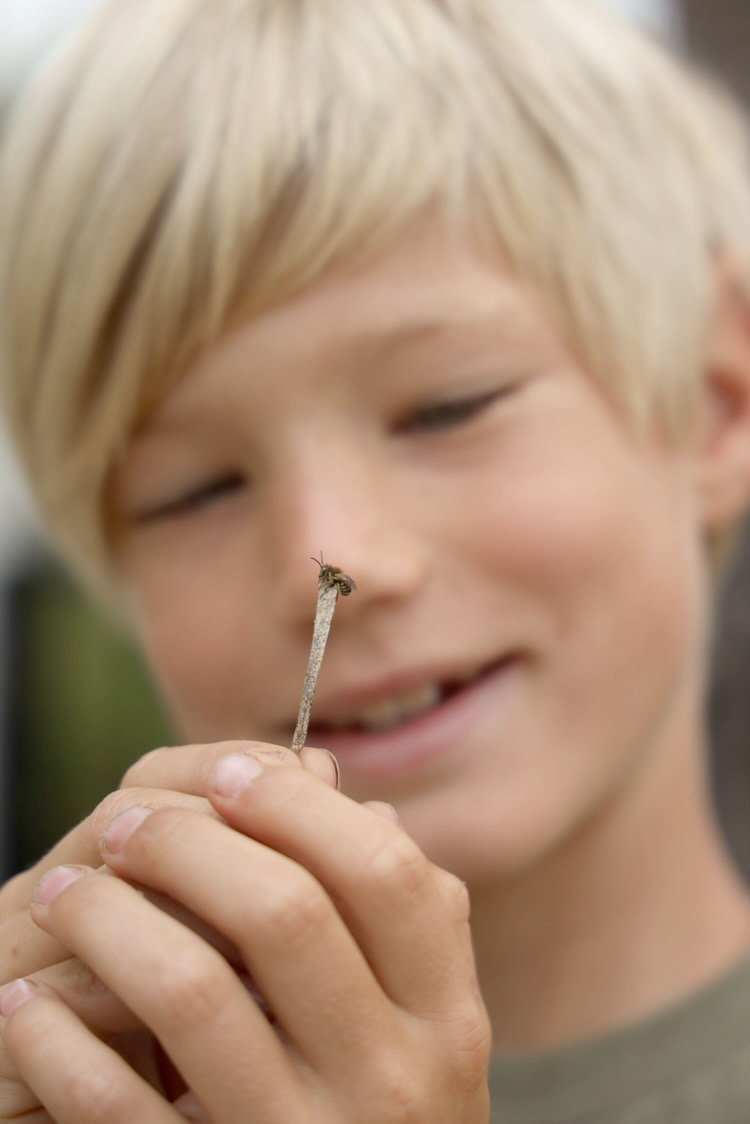
Watching these industrious pollinators provides a natural rhythm to the afternoon that pairs perfectly with other screen-free activities designed to keep young minds engaged with the world right outside the back door.
Activity 1: The Leaf Puzzle Detective
Hand each kid a magnifying glass and look for leaves with clean, round marks. Ask your detective to find three and guess which plant the bee prefers.
Activity 2: The Ten-Minute Sit-and-Watch
Set a timer for ten minutes and sit quietly near the bee house. Kids can count bees that enter a tube.
Activity 3: Build a Bee Observation Journal
Give each child a notebook with three columns: date, weather, and what they saw. Drawings count as entries. Add a simple tally of bees entering tubes and flowers visited.
Activity 4: The Flower Buffet Survey
Walk the garden and list flowers in bloom. Mark which ones get bee visits. This activity can help children observe flowers in the garden.
Activity 5: Shadow the Nesting Tube
Choose one tube and check it each morning. Kids watch it slowly fill with leaf pieces and pollen until the entrance is sealed. That sealed tube is a full nursery. It is the single best way to make pollination feel real instead of abstract.
Activity 6: Act Out the Pollination Relay
No bees required for this one. Give one kid a colored ball of paper as pollen and have them “fly” from flower to flower, dropping a little pollen each stop. Then swap roles.
Activity 7: The End-of-Summer Bee Recap
In late summer, sit down with the journal and count the sealed tubes. Celebrate the season’s work. Then store the tubes for winter, following our guidance on caring for bee nesting tubes. Kids who help with storage remember the full life cycle next spring.
Matching Activities to Your Child’s Age (and Attention Span)
Younger kids may prefer movement and short windows. Older kids can try journals and careful watching. Here are ways to match the activities to different ages and attention spans.
| Age | Best Activities | Time | Why It Works |
|---|---|---|---|
| 3-5 | Pollination relay, sit-and-watch | 5-10 min | Movement and simple counting |
| 6-8 | Leaf detective, flower survey | 15 min | Hands-on discovery |
| 9-11 | Observation journal, tube shadowing | 20 min | Records and patterns |
| 12+ | Full season journal, bee recap | 30 min | Real data and ownership |
Toddlers and preschoolers (ages 3-5): movement first
At this age, sitting still is a skill still under construction. Lean on the pollination relay and the ten-minute sit-and-watch, and keep sessions short enough to end while it is still fun. Swap the magnifying glass for a big plastic one, small hands and real glass are a bad combo. Counting bees out loud (“one, two, three!”) turns observation into a game. Expect wiggles. Wiggles are fine.
Early elementary (ages 6-8): hands-on detectives
The leaf puzzle detective and the flower buffet survey hit the sweet spot here. Kids this age love a mission with a clear win, find three cut leaves, spot five bee visits. Give them a clipboard and a chunky pencil, and let them draw instead of write if they prefer. A common pattern is that the drawing becomes the story they tell at dinner.
Upper elementary (ages 9-11): records and patterns
Now the observation journal earns its keep. These kids can track dates, weather, and bee counts, and they start noticing patterns on their own, more traffic on warm mornings, certain flowers getting ignored. Tube shadowing works well here too, because checking one tube daily rewards patience with a visible payoff: a sealed entrance.
Tweens and teens (ages 12+): real data and ownership
Older kids can run the full-season journal and the end-of-summer recap, counting sealed tubes and comparing notes week to week. Hand them the responsibility for the journal and the winter storage check. Ownership is the hook, this is their project, not a worksheet. If they want to go further, the pollination relay can become a mini lesson in pollen transfer and garden yields.
Mixed-age groups: one activity, three jobs
Match the activity to the attention span, not the birthday. Short and lively beats long and perfect every time, and the journal will still be there when they are ready for it.
Set Up a Pollinator House and Let the Show Begin
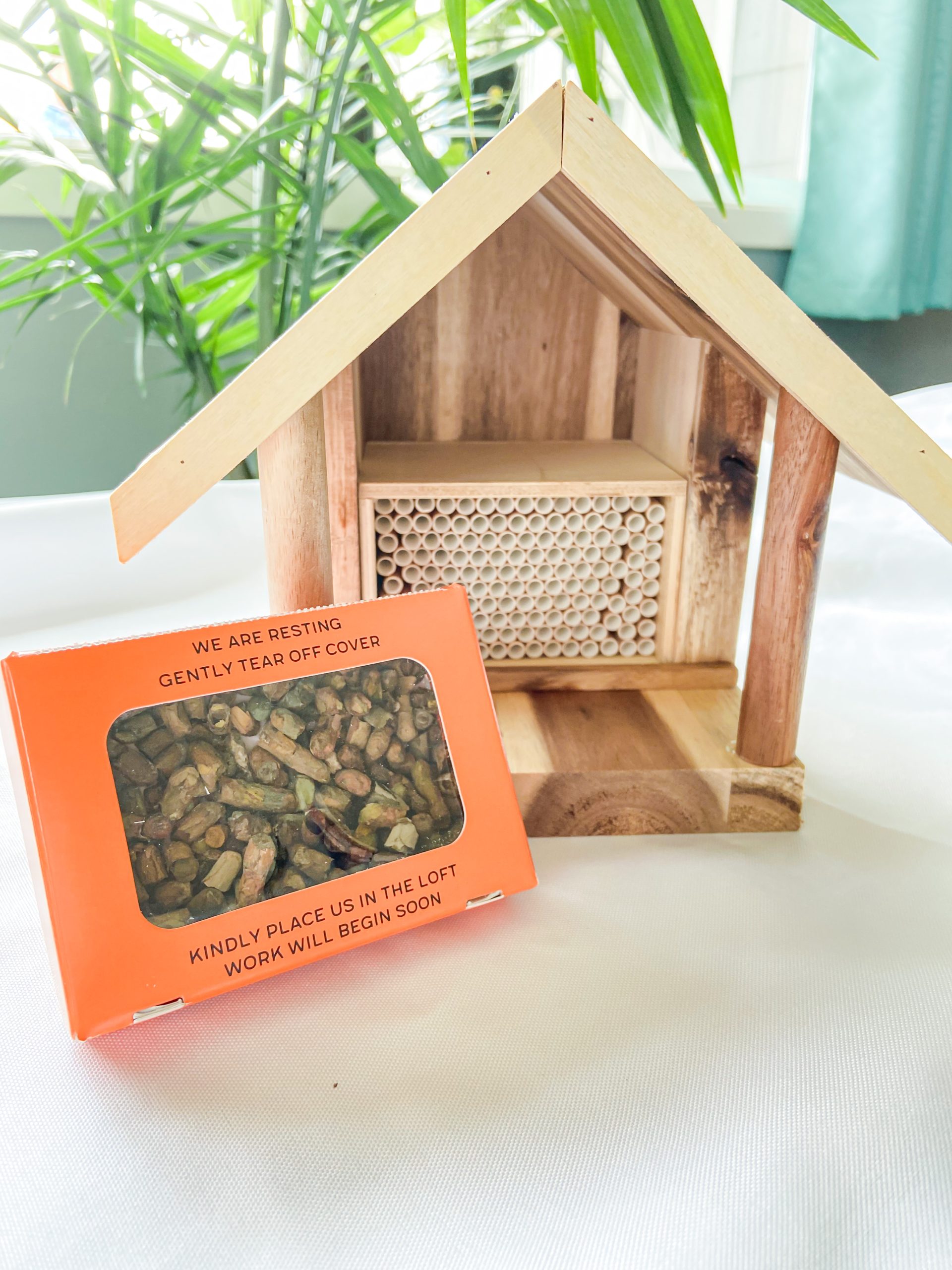
Our all-in-one pollinator house kit with bees includes a bee home, leafcutter bee cocoons, and smooth paper-like nesting straws.
One customer said: “Since putting up my bee house I’ve seen twice my harvest so far.”
We have been a family bee business since 1990. Get started with Kind Bee Farms.
Frequently Asked Questions
Are leafcutter bees dangerous to children?
Leafcutter bees are among the gentlest pollinators you can invite into a garden. They are solitary bees, not hive defenders, so they have nothing to protect and no swarm to guard. They only sting if handled roughly or trapped against skin, and their sting is described as mild. Teach kids to watch with eyes and not fingers, keep a short distance from nesting tubes, and the risk stays very low. Most families find the bees far more interested in flowers than in people.
How can children tell a leafcutter bee from a honey bee?
Look at the body shape and the belly. Leafcutter bees have a fuzzy, stout body and carry pollen on the underside of the abdomen, so you may spot a golden patch under the belly. Honey bees are slimmer, carry pollen in baskets on their hind legs, and live in large colonies. Leafcutter bees are also solitary and nest in tubes or holes rather than hives. A quick side-by-side comparison in a garden journal helps kids lock in the difference.
What do leafcutter bees do with pieces of leaves?
Female leafcutter bees snip neat oval and round pieces from leaves, then carry them back to a nesting tube. Inside, they line the tube with leaf pieces to form small cells, stock each cell with nectar and pollen, lay an egg, and seal it. The leaf walls protect the developing bee. Kids can spot the evidence as crescent-shaped notches along the edges of host plants like redbud or plants in the legume family, tomatoes, peppers, and eggplants.
When are leafcutter bees most active, and what can kids record in an observation journal?
Leafcutter bees are warm-weather bees, typically active through late spring and summer, and they slow down in cool or rainy conditions. On a warm sunny morning, plan a ten-minute watch. In a journal, kids can record the date, time, weather, which flowers the bees visited, leaf notches spotted, nesting tube activity, and a quick sketch. Over a season, those notes turn into a real record of the leafcutter bee life cycle from emergence to nest building.
The hardest part is not the setup. It is getting everyone back inside for dinner.
